
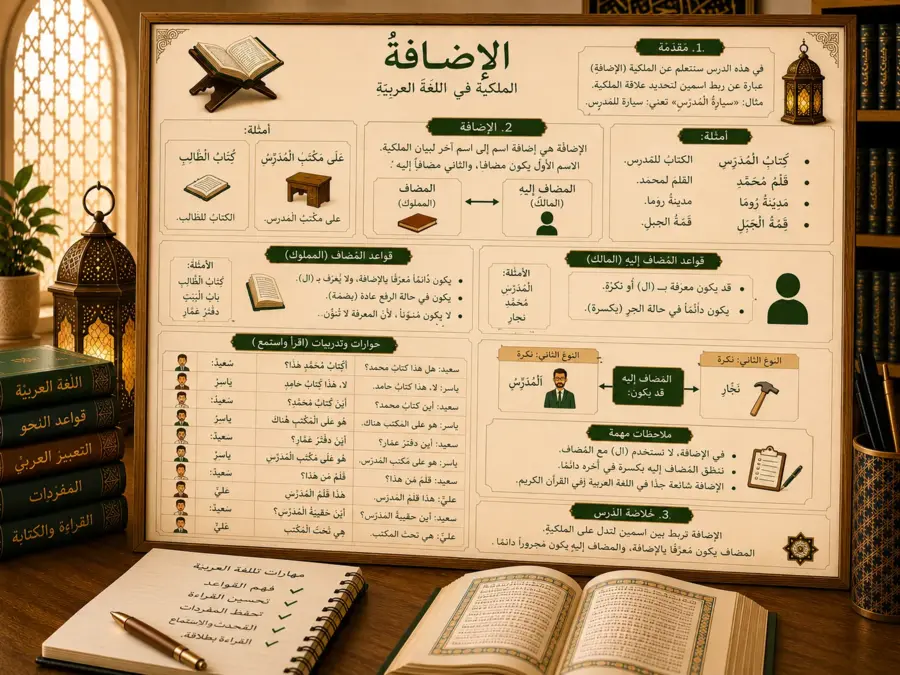
In this Arabic grammar lesson, we will study the Arabic possession structure known as الإِضَافَةُ (Idafa). This is one of the most important concepts in Arabic grammar and is used to express ownership, relationships and connections between two nouns.
Understanding the Arabic idafa construction is essential for students who want to learn Arabic online, improve their Arabic reading skills and master Modern Standard Arabic.
What Is Idafa in Arabic?
The word الإِضَافَةُ literally means "addition" or "annexation". In Arabic grammar, it refers to a construction that links two nouns together to express possession or association.
Examples:
- كِتَابُ الْمُدَرِّسِ : the teacher's book;
- قَلَمُ مُحَمَّدٍ : Muhammad's pen;
- مَدِينَةُ رُومَا : the city of Rome;
- قِمَّةُ الْجَبَلِ : the summit of the mountain.
The Structure of an Idafa Construction
An idafa consists of two nouns:
- the possessed noun, called مُضَافٌ (mudaf);
- the possessor, called مُضَافٌ إِلَيْهِ (mudaf ilayh).
Example:
كِتَابُ الْمُدَرِّسِ
In this phrase:
- كِتَابُ is the mudaf (the possessed item);
- الْمُدَرِّسِ is the mudaf ilayh (the possessor).
Rules of the Mudaf
The first noun in the idafa construction follows specific grammatical rules.
- It never takes the definite article ال.
- It never takes tanwin.
- It becomes definite through its relationship with the second noun.
- It may be nominative, accusative or genitive depending on its grammatical role.
Examples:
- كِتَابُ الطَّالِبِ : the student's book;
- بَابُ الْبَيْتِ : the door of the house.
Rules of the Mudaf Ilayh
The second noun also follows specific rules.
- It can be definite or indefinite.
- It is always in the genitive case.
- It carries a kasra or kasratain.
Examples:
- إِمَامُ مَسْجِدٍ : the imam of a mosque;
- مَكْتَبُ الْمُدَرِّسِ : the teacher's desk.
How to Express Possession in Arabic
Arabic uses idafa instead of a separate word equivalent to the English apostrophe-s.
Compare:
| English | Arabic |
|---|---|
| The teacher's book | كِتَابُ الْمُدَرِّسِ |
| Muhammad's pen | قَلَمُ مُحَمَّدٍ |
| The city of Rome | مَدِينَةُ رُومَا |
Examples of Arabic Idafa
- كِتَابُ حَامِدٍ : Hamid's book;
- حَقِيبَةُ الْمُدَرِّسِ : the teacher's bag;
- دَفْتَرُ عَمَّارٍ : Ammar's notebook;
- مَكْتَبُ الْمُدَرِّسِ : the teacher's desk.
Practice Dialogue Using Idafa
Example dialogue:
أَكِتَابُ مُحَمَّدٍ هَذَا؟
Is this Muhammad's book?
لَا، هَذَا كِتَابُ حَامِدٍ
No, this is Hamid's book.
أَيْنَ دَفْتَرُ عَمَّارٍ؟
Where is Ammar's notebook?
هُوَ عَلَىٰ مَكْتَبِ الْمُدَرِّسِ
It is on the teacher's desk.
Common Beginner Mistakes
Students often make the following mistakes:
- adding ال to the mudaf;
- using tanwin on the mudaf;
- forgetting that the mudaf ilayh must always be genitive;
- confusing possession with possessive pronouns.
Learning these rules early makes Arabic grammar much easier to understand.
Learn Arabic Grammar with a Teacher
The idafa construction is a fundamental concept in Arabic grammar, Modern Standard Arabic and Quranic Arabic.
To continue your studies, you can follow our online Arabic classes, study Modern Standard Arabic online lessons, improve your Quranic Arabic or review the Arabic alphabet.
Réservez votre essai gratuit de 30 minutes
Formulaire d'inscription
Conclusion
In this lesson, we studied the Arabic idafa construction and learned how Arabic expresses possession. We saw the difference between the mudaf and the mudaf ilayh, and the grammatical rules that govern each part of the construction.
Mastering idafa is essential for understanding Arabic grammar and reading Arabic texts correctly. With regular practice and guidance from a qualified Arabic teacher, this important concept becomes much easier to use.



Aucun commentaire
Aucun commentaire pour le moment.